
Why the new grads are not okay
AI is dismantling the talent pipeline in tech

a personal update:
I’ve launched a startup! It’s called Del, your personal AI executive assistant. Harvey had Donna; now you have Del.
What makes it different is it tries a lot harder than any other AI assistant to 1. learn about you, 2. take initiative to help rather than sitting there waiting for you to tell it what to do. You’d be surprised at the difference between having to think of all the solutions to your problems versus just having solutions sent to you :)
You can try it free for now at withdel.com.
I’m not interested in long run labor scenarios of AI, which range from cataclysm to utopia depending on the degrees of connection from your source to equity in OpenAI.
What’s clear is that in the short term, labor displacement from AI will be unprecedentedly fast, painful, and disproportionately affect entry-level roles, starting in tech.
Before this creative destruction rebuilds entire industries, it will first dismantle the existing talent pipeline. New-grads over the next five years will find that the old corporate nursery where Big Tech absorbed graduates by the thousand, paid them to learn on real systems, and spat them out three years later as mid-level engineers, has largely closed its doors to them. Firms reconsider the calculus of hiring juniors in the age of AI leverage. Whatever Altmanian abundance lies beyond the horizon, the first act of AI for an entire generation of young, educated Americans is a morbid interregnum.
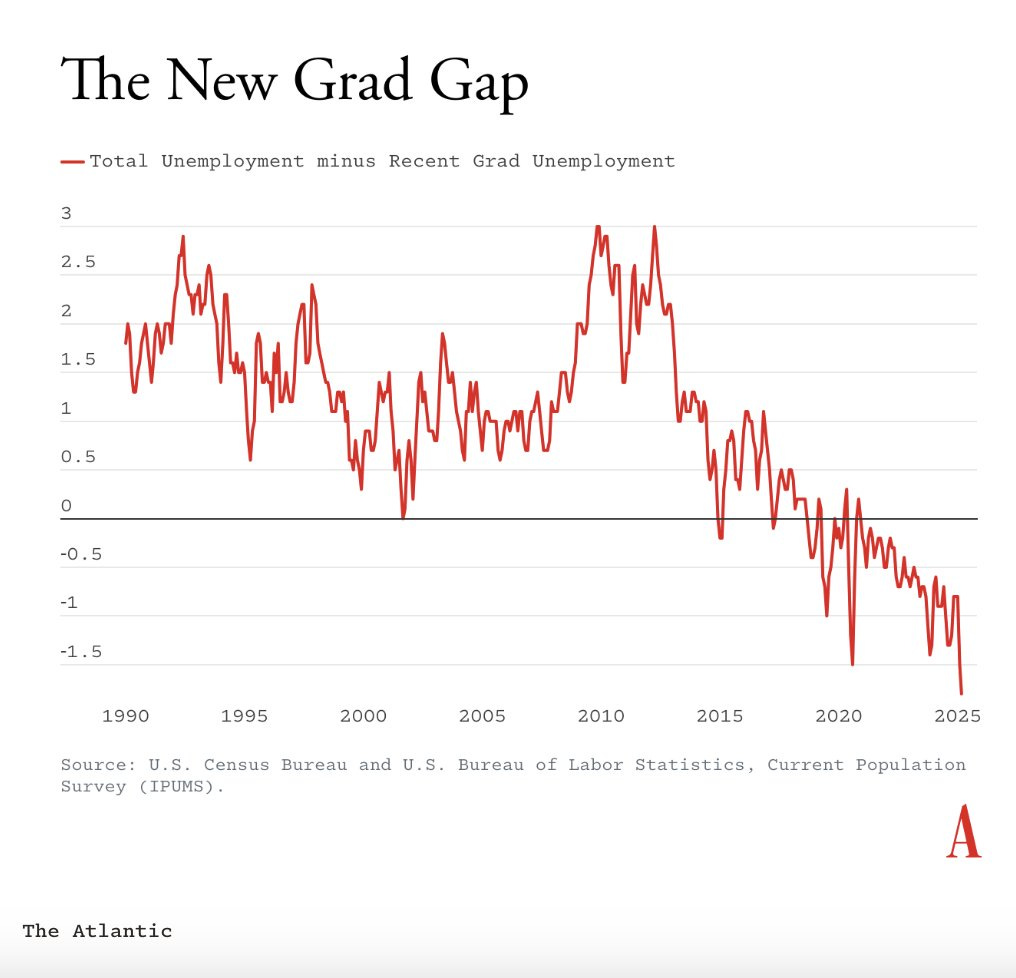
Junior jobs are on the chopping block rather than senior ones, because AI is complementary to calibrated judgment. The senior knows when the contract clause is subtly wrong, when the financial model’s assumptions are unrealistic, when the system design is over-engineered. Juniors ship hallucinations because they can’t tell the difference.
It's faster to teach a senior to prompt than to teach a junior good judgment. Companies chasing AI leverage will increasingly invest in experienced workers over costly apprenticeship pipelines. Slow adoption of new AI paradigms and persistent demand for legacy skillsets will shield existing workers, while opportunities start vanishing for new entrants.
CEOs like Jack Dorsey, who just laid off 4000 employees at Block, believe that only deep, ambitious restructuring rather than timid retro-fitting, will unlock the full potential of AI on organizational productivity. They’re right, though most less hard-charging CEOs will prefer a quieter and more cautious approach, using hiring freezes over sweeping layoffs to bide time while they unblinkingly watch the AI-native startups figuring out the new org paradigms on the frontier. The axe hovering over the entry-level will fall slowly and then all at once.
Next a generational Gramsci gap emerges: the post-Covid cohort of new-grads caught between an evaporating old entry-level (and ZIRP regime) and a new AI-fluent entry-level struggling to be born. Without the old apprenticeship ladder to climb, these new-grads must independently cultivate AI fluency and a competitive technical skillset—that, or, perhaps, grad school as a waiting room.
Law school applicants surged 18% in the 2025 cycle and are tracking 33% higher in 20261. Business schools experienced rising application growth last year, with total applications increasing by 7% in 20252. Historically, grad school applications rise both during booming economies with rising wage premiums for advanced degrees and recessions as young people “hide” from a bad economy.
Which scenario are we in right now? At Harvard Business School, 23% of last spring's job-seeking MBAs were still looking three months out — up from 20% the year before, and more than double the 10% figure from 2022.3 So much for the return on specialization.
Yet, neither are we in a recession—not if you ask NBER4 and not if you look at the earnings reports. In Q1 2026, the estimated YoY earnings growth rate for the S&P 500 is 12.6%, soon to mark the sixth-straight quarter of double-digit YoY earnings growth.5 Mag 7 (Google, Apple, etc.) reported 27.7% YoY earnings growth in Q1 2025, beating estimates by 14.9%, while Q1 2026 estimates stand at 22.8% aggregate YoY growth.
Zooming in on cloud revenue: Azure, GCP, and AWS grew 24–48% YoY in Q2 FY2026 on backlogs totaling over $1 trillion—each growing faster than revenue itself. The three are funding the boom with roughly doubled capital expenditure year-over-year, and demand is still outrunning supply.
At the same time, new-grad intake across Big Tech is down 25% from 2023 (not just from the ZIRP peak, but from an already-corrected baseline) and new grads now comprise just 7% of total Big Tech hires, versus 15% pre-pandemic6. Meta, despite record 2025 revenue and free cash flow, just announced another 8,000 layoffs for May 20267.
This is not a story of post-COVID tech austerity but substitution. AI now writes more than 25/50/75% of new code at Big Tech, depending on who you ask8 and economists have begun describing AI as a seniority-biased technological change9—one that erodes the apprenticeship tasks that historically made junior hires economical, while raising the premium on senior engineers who can audit autonomous systems. Tech wants competent engineers more than ever, but where will they come from if new ones stop being trained now?
Tech is the leading indicator. AI is adopted first in tech because the AI-software loop closed first, but the same dynamic will reach law firms, consulting firms, banks, accounting firms, ad agencies—diffusing outward with each quarter. In Technological Revolutions and Financial Capital, Perez distinguishes between the installation phase of a technological revolution—when the core infrastructure is built, capital floods in, and the frontier sector reorganizes itself—and the deployment phase, when the rest of the economy absorbs the new paradigm and remakes itself around it. We’re still in installation; the junior software engineer is just the first to experience what nearly every junior knowledge worker will face within the decade.
So. The Altmanian future may still arrive; someday the AI transition will reach down to transform the entire talent pipeline, and a new entry-level job market will emerge.
But between here and there sits a decade. In every technological revolution from steam engines to the microprocessor, the sociopolitical transformation has chased the techno-economic one from behind. That lag is measured in careers delayed and years spent at home filling out job applications. The graduating classes of the next five years will enter an economy that is growing, profitable, and largely closed to them.
I have a half-brother in college, and whenever I look at the stats, I dread the job market (or lack thereof) that awaits him.
We need to move beyond an economic structure that rewards only contributions measured by the stock market.
I don't know, I feel like it has more to do with zero interest rates ending than AI. Also it feels like 90% of new grads cheated the whole time through college and don't actually know how to do anything.