
Chinese street markets 101
microeconomics and shamelessness in the motherland

a personal update:
I’ve launched a startup! It’s called Del, your personal AI executive assistant. Harvey had Donna; now you have Del.
What makes it different is it tries a lot harder than any other AI assistant to 1. learn about you, 2. take initiative to help rather than sitting there waiting for you to tell it what to do. You’d be surprised at the difference between having to think of all the solutions to your problems versus just having solutions sent to you :)
You can try it free for now at withdel.com.
Street hustlers or How I learned to respect the hustle
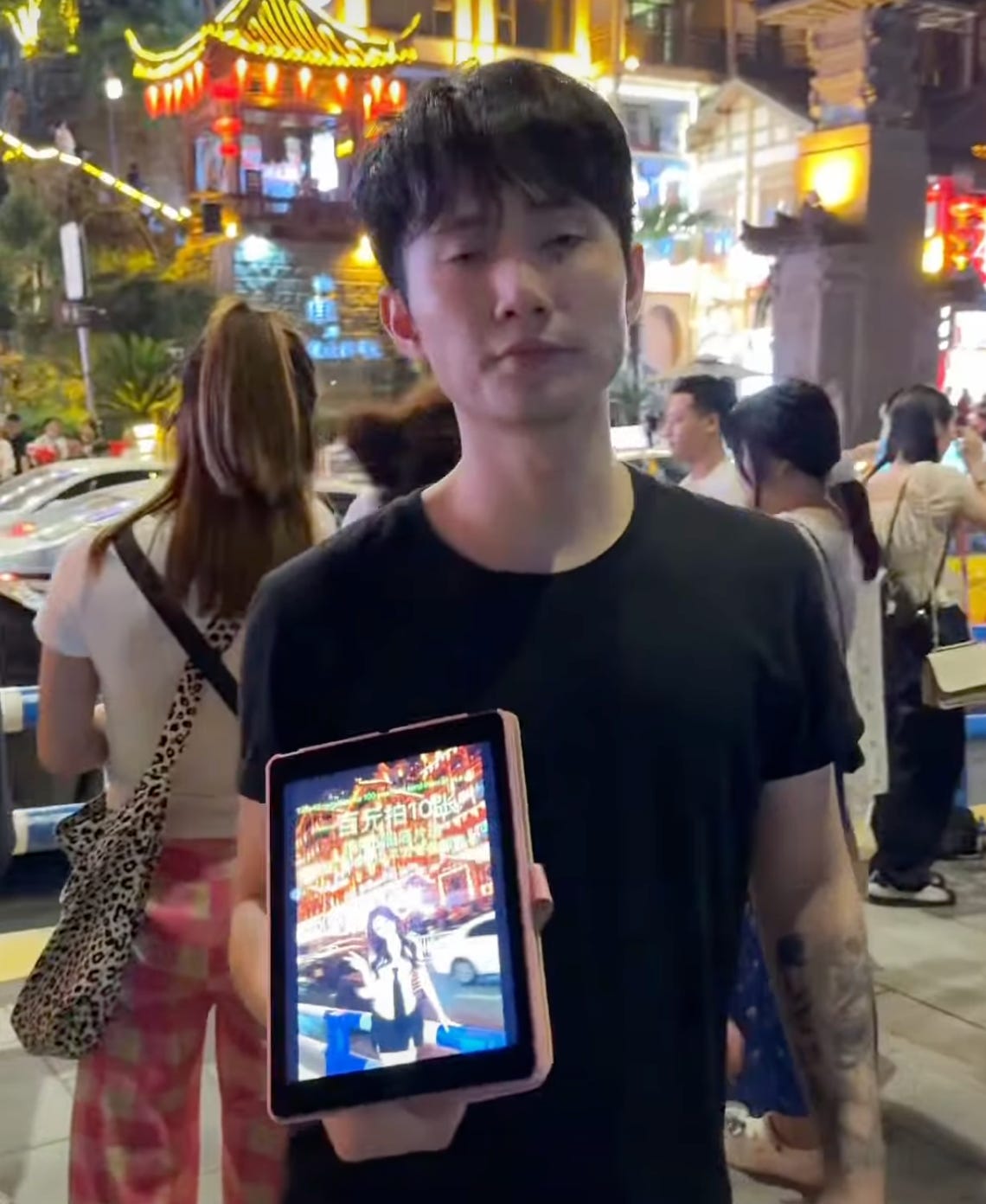
The photo hawkers stationed at every scenic overlook understand the first law of marketing: sell the fantasy, not the product.
They don’t pitch you on photo quality or printing speed. They wave their iPad in front of your face at maximum brightness like a halo in the night. On it, a breathless vision of beauty stands in front of the landmark—pose, hair, lighting, perfect. Squint and you start seeing yourself in the photo. What are you waiting for?
The street performers, storefront clackers, hawkers with megaphones shouting over one another know something else too: all revenue is downstream of attention. The result may be an incessant din rising to screeching cacophony at the worst of times, but I respect the hustle.
Hawkers ask very quickly whether you’ll buy or not. No elaborate pitch, no relationship-building preamble, just a fast filter to determine if you’re a prospect worth pursuing. They don’t waste time on maybes. This feels abrasive if you’re used to the padded dance of Western retail, but it’s brutally optimized for their environment. Every second spent on someone who won’t buy is a second not spent finding someone who will.
All of them know that persistence pays. The hustlers will follow you and ask once, then twice, then three times. They will keep going, right up to the moment before you start swinging, and then they will walk off and immediately accost the person a few feet to your left. To be very honest, I find this level of shamelessness absolutely exquisite.
In the West we have YouTubers embarking on 100 Rejections in 100 Days challenges. In China they try for 100 rejections in 1 hour. And then 1 out of the 100 times, it works. I know because I watched it happen—like watching Federer backhand, just pure poetry in motion. As long as they were off my ass, I was thinking to myself, I really do respect the hustle.
Why are there so many identical goddamn spicy oil stores?
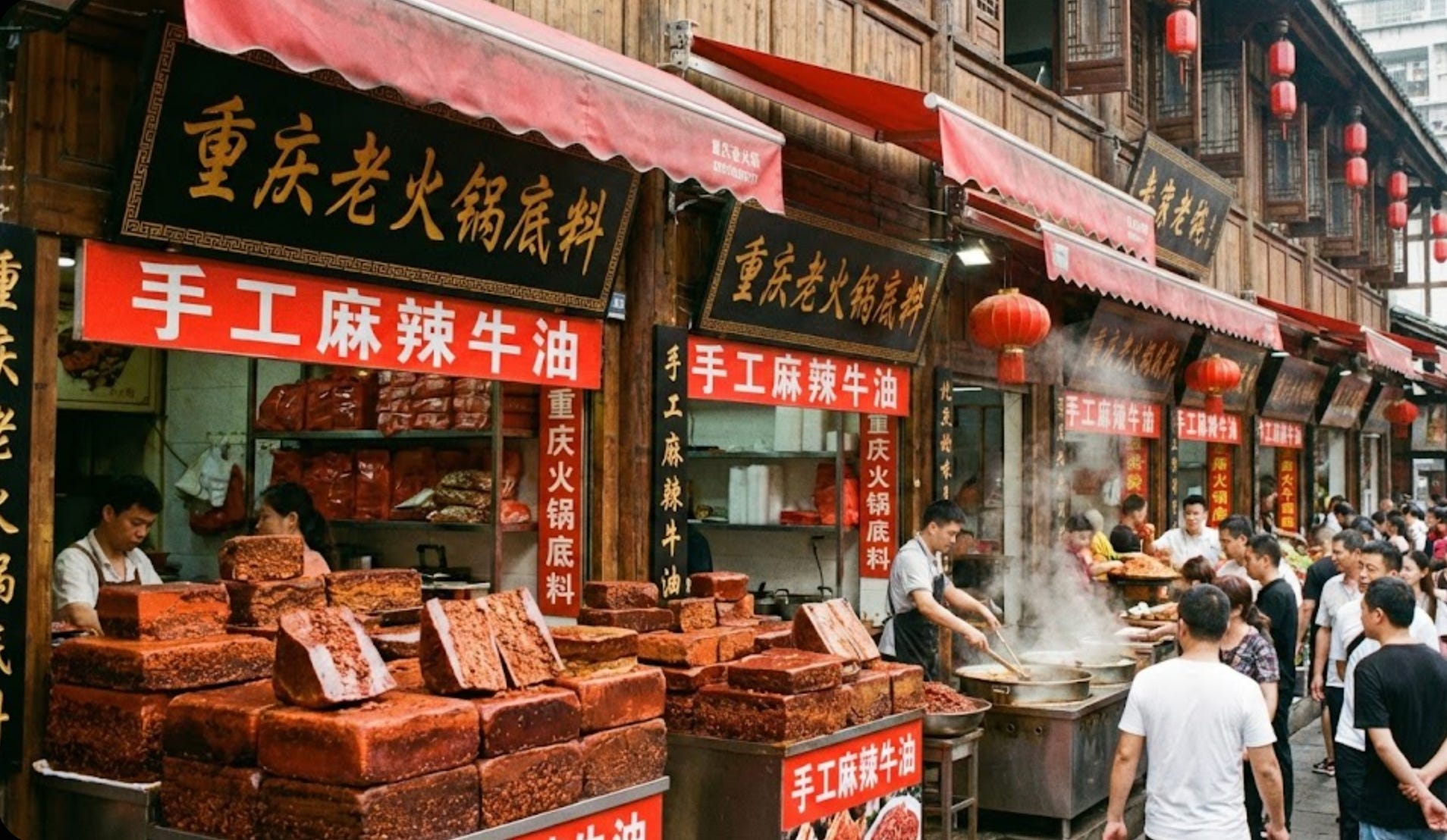
Stroll through any tourist Chinese street market you’ll see what I mean.
On my trip to China, I explored 7 street markets across 4 cities and found that all of them had one core set of products that were copy pasted en-masse, like Thneedville townhouses. You’ll see a dozen 百香果 fruit juice carts packed like sardines in Guilin, or hotpot oil vendors in Chongqing, or panda souvenir stalls in Chengdu, or stinky tofu stores in Changsha.
These markets have been around a long time, so this is clearly some sort of Nash equilibrium, albeit a confusingly homogenous one. If every store looks almost exactly the same and sells the same products, shouldn’t you be incentivized to sell something else to stand out? Why compete with them?
In microeconomics, Hotelling’s Law describes a scenario in which competing sellers are incentivized to minimize differentiation to maximize their share of customers. If Vendor A sells a spicy noodle dish and Vendor B sells a sweet one, they split the market. If Vendor B moves their flavor profile closer to Vendor A’s (the “median” taste), they keep their original customers and steal some of A’s. Eventually, both vendors converge on the exact same “center” product to minimize the risk of losing the mainstream customer.
In urban economics agglomeration effects is the idea that proximity creates efficiency. If stalls were scattered around the city, a customer would have to expend energy to find them. By clustering, the market reduces the consumer’s search cost. Demand spills over between stalls even if the offering is identical. This is most exaggerated in the case of the street photographer, which can only serve one customer at a time.
Differentiation is only valuable when customers can perceive, value, and pay for it. There is low marginal return to being different in a street market because most tourists pass through once and never return. Without any digital platform to list and rank the stalls, tourists will just look for the most quintessential products by default (e.g. panda toys in Chengdu). Perhaps there’s just not much marginal return to investing in quality or novelty compared to just sticking to what works.
So that’s the game: the product is almost incidental, the business is more a commodity wrapper around distribution: how loud you can shout, whether you secured the corner spot, how aggressively you can thrust samples into hands.
At some point I realized that this was all startlingly similar to the marketplaces of generative AI apps in the US. Hundreds of minimally-differentiated thin AI wrapper companies running viral TikTok guerrilla campaigns, funneling millions of users into slick app onboarding flows optimized for converting 1 in every 100, winning on volume. Shout loudly, capture attention, convert quickly, and extract value before the user churns and never returns.
On haggling
The first time I tried to haggle I felt physically ill. The vendor quoted a price, I knew it was inflated, I knew the game was to counter, but I didn’t want to do it. My chest tightened, heat rising in my face. I pushed words about the price being too high out of my mouth but I knew, they knew, my voice showed, my face showed, that I wasn’t going to drive a hard bargain.
I paid full price and walked away feeling stupid.
Worse than that though, the feeling I probably hate the most in this world is cowardice. I have a memory from a decade ago, still crisp like 4K video, of myself in summer camp sitting on some stone blocks with a few friend-strangers, while a vibrant mass of campers dance in a circle near the center of the field. We aren’t chatting with each other, no, we’re sitting in complete silence, each of us utterly absorbed in gazing longingly at the circle.
This bleak clip loops through my head every time I let fear stop me from doing something I want to do.
Watching my mom haggle with the vendors drove it home how entirely fictional and manufactured my fears are. They’re not offended by lowball offers. They expect them. They counter, you counter, everyone knows the dance. The offense I was so afraid of causing existed only in my head. Framing it as a social ritual helped.
The lesson is simple—ask for what you want. Don’t be afraid of rejection. And definitely don’t be afraid of offending the other person or being embarrassed to propose something “wrong.”
And, I remembered a deeper truth I once read. For whatever action scares you (and isn’t life-threatening), remember this surefire way to eliminate the fear: do it 100 times.
"what chinese street vendors taught me about ai consumer apps" lolol
first time ive heard of hotelling's law, great nugget of wisdom, ty
❤️